







How European schools teach regional languages
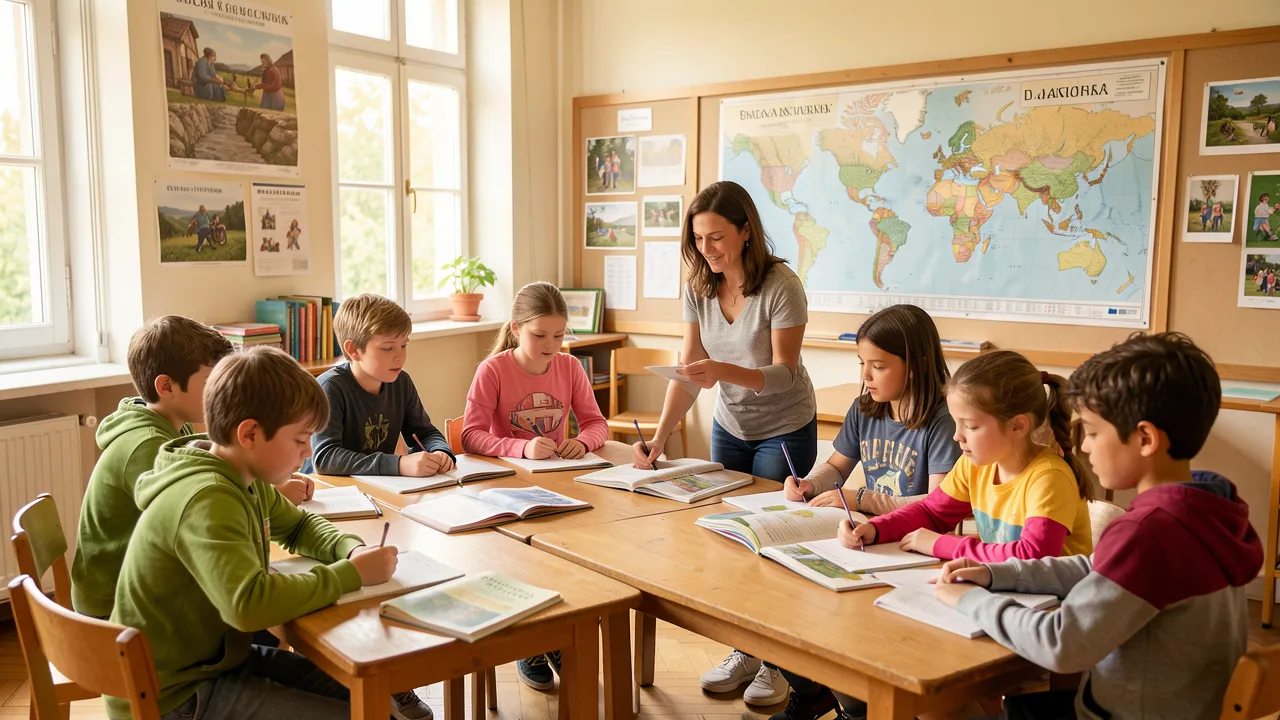
Regional languages carry local history, family memory and ways of speaking that may not appear in national textbooks. Across Europe, schools play a varied role in keeping these languages visible and usable. Depending on the country, pupils may encounter a regional language as a subject, as the language of instruction, or through cultural projects linked to their community. For families, these programmes can offer a meaningful connection between education and local identity.
Regional language education follows different national models
European education systems do not treat regional languages in the same way. Some countries grant them substantial legal recognition, while others leave most decisions to local authorities, individual schools or voluntary associations. The availability of teaching may therefore differ greatly between regions within a single state.
In Spain, several autonomous communities use Catalan, Basque or Galician as teaching languages alongside Spanish. Pupils can learn science, history and mathematics through the regional language, rather than studying it only in a short weekly lesson. In Wales, Welsh-medium schools provide a comparable model, with Welsh used across much of the curriculum.
Elsewhere, the regional language is commonly taught as a separate subject. In France, Breton, Corsican, Occitan, Alsatian and Basque may be offered in certain areas, although access depends on local provision. In Italy, Sardinian, Friulian and Ladin initiatives often rely on regional policies and school-level partnerships.
To place these arrangements in context, Explore Europe's Linguistic Evolution and Historical Influences traces the historical forces that have shaped language use across the continent.
Immersion schools create daily opportunities to use the language
Immersion education is among the strongest approaches for developing active language skills. Rather than treating the language as an object of study, it makes it part of ordinary classroom life. Pupils hear it during instructions, discussions, group work and school activities.
Irish-medium schools, known as Gaelscoileanna, use Irish for teaching in many subjects. In the Basque Country, families may choose from different models that combine Basque and Spanish to varying degrees. These options recognise that pupils enter school with different linguistic backgrounds.
Immersion does not automatically mean excluding the national language. Many programmes aim for bilingual competence, giving pupils secure literacy in both languages and preparing them for further study and employment.
Teachers connect language lessons with local culture
A regional language gains relevance when pupils encounter it beyond vocabulary lists and grammar exercises. Teachers often link learning to songs, oral histories, place names, theatre, food traditions and local environmental knowledge. Such activities help students understand that language is also a social practice.
Schools may invite older speakers to record stories, organise interviews with local artists or create bilingual maps of their town. A class in a Frisian-speaking area of the Netherlands, for example, might collect regional expressions used by grandparents and compare them with standard Dutch. In a Sami school in northern Europe, lessons can include traditional knowledge connected to land, seasons and reindeer herding.
These projects also create space for pupils who understand a regional language at home but feel less confident speaking it publicly. A supportive classroom can reduce the idea that a local variety belongs only to older generations or private family settings.
The broader interaction between schooling, screens and everyday expression is examined in Digital Media's Influence on European Language Trends. Digital tools can support regional language learning through podcasts, subtitled videos, online dictionaries and student-made media.
Access often depends on resources and teacher training
Despite strong community interest, regional language programmes face practical limitations. Small schools may struggle to find qualified teachers. Teaching materials can be scarce, particularly for languages with several writing traditions or limited standardised terminology for modern subjects.
Teacher training is therefore a major factor. Educators need linguistic competence, but they also need methods for bilingual classrooms, mixed ability groups and pupils whose exposure at home varies widely. Universities, regional language institutes and cultural organisations can help develop these skills.
Parents may also face uneven access. One town may offer a well-established bilingual school, while a nearby area provides only an optional weekly lesson. Transport, enrolment rules and the availability of nursery education can shape whether a family can choose a regional-language pathway.
For schools serving linguistically mixed communities, Effective Multilingual Communication Strategies in Europe offers useful perspectives on clear communication with families and inclusive language planning.
Assessment should support learning rather than narrow it
Assessment can be sensitive in regional language education. If examinations focus only on formal grammar, pupils who speak the language naturally at home may not receive credit for their oral ability. Conversely, pupils learning it at school need encouragement to communicate without fearing every mistake.
Balanced assessment can include conversation, reading, writing, presentations and collaborative projects. It should acknowledge both standard forms and locally meaningful varieties, while giving pupils the tools to communicate across regions.
Communities strengthen what schools can begin
Schools cannot carry language revitalisation alone. A pupil who learns a regional language in class benefits most when it is also heard in libraries, sports clubs, local media, public services and family life. Community partnerships make school learning more durable and practical.
Regional language organisations often provide books, music, theatre workshops and youth events. Municipalities can support bilingual signage and public activities. When students see their language used by journalists, entrepreneurs, artists and local officials, they can better imagine a future in which it has a place.
Diversity of European Languages: Major and Minority provides further background on the many language communities whose presence shapes Europe’s cultural landscape.
Key points to remember:
- Regional languages may be taught as subjects or used across the curriculum.
- Immersion programmes can build everyday confidence in speaking and writing.
- Cultural projects connect classroom learning with local communities.
- Teacher supply, funding and materials strongly affect access.
- Long-term vitality depends on support beyond the school gates.
Regional language teaching keeps Europe’s linguistic heritage active
When schools make room for regional languages, they give pupils more than an additional subject. They provide access to local stories, intergenerational relationships and forms of expression that might otherwise become less visible. For you as a parent, educator or community member, understanding the available models can help you assess how a school supports both bilingual learning and the living heritage of its region.